Free seed starting schedule
Seed Starting Calculator
This seed starting calculator counts back from your last frost date and shows, for each crop, when to sow indoors, when to plant out and when to sow straight into the ground. If you already entered your ZIP on another page here, your frost date is filled in.
Seed Starting Calculator
Loading the tool…
How it works
- Set your frost date. Enter a ZIP, or keep the one you used on the frost date calculator.
- Pick your crops. Each one gets a bar across the season: start indoors, transplant, direct sow.
- Match your seed packets. If a packet says 4 to 6 weeks and we say 6 to 8, change it. The bar moves.
- See what's due now. The "sow this week" list shows what to start today. Download the dates to your calendar, print the season, or save a CSV.
Where the data comes from
Frost dates come from NOAA NCEI U.S. Climate Normals 1991–2020. Sowing windows in weeks come from the extension sources listed below; edit them to match your seed packet.
- NOAA NCEI U.S. Climate Normals: where the frost probabilities come from.
All 33 sources used by the tools on this site
- Small-Scale Gardening (square foot gardening) (Clemson Cooperative Extension, Home & Garden Information Center)
- Starting Seeds Indoors (HGIC 1259) (Clemson Cooperative Extension, Home & Garden Information Center)
- Tomato Insect Pests (Clemson Cooperative Extension, Home & Garden Information Center)
- Storing Vegetable and Flower Seeds (7.221) (Colorado State University Extension)
- CMG GardenNotes #720: Vegetable Planting Guide (Colorado State University Extension (copy hosted by UC ANR))
- Vegetable Planting Guide (Hort 52) (Cornell Cooperative Extension of Rockland County)
- How to Store Seeds and Test Germination Rates (Iowa State University Extension and Outreach)
- Eastern North Carolina Planting Calendar for Annual Vegetables, Fruits, and Herbs (NC State Extension)
- Culinary Herbs for Oklahoma Gardens: Culture, Use and Preservation (HLA-6037) (Oklahoma State University Extension)
- Sowing Annual Seeds (Penn State Extension)
- HO-66-W: The Fall Vegetable Garden (Purdue University Extension)
- Companion Planting Chart (Companion Planting for Edible Crops) (UC Master Gardener Program, University of California ANR (after ATTRA))
- Marigolds (Tagetes spp.) for Nematode Management (ENY-056) (University of Florida IFAS Extension)
- Will My Seeds Still Grow? Seed Viability and Germination (University of Illinois Extension)
- Basil (University of Illinois Extension (Herb gardening))
- Chives (University of Illinois Extension (Herb gardening))
- Cilantro (University of Illinois Extension (Herb gardening))
- Dill (University of Illinois Extension (Herb gardening))
- Mint (University of Illinois Extension (Herb gardening))
- Oregano (University of Illinois Extension (Herb gardening))
- Parsley (University of Illinois Extension (Herb gardening))
- Rosemary (University of Illinois Extension (Herb gardening))
- Sage (University of Illinois Extension (Herb gardening))
- Thyme (University of Illinois Extension (Herb gardening))
- Companion planting in home gardens (University of Minnesota Extension)
- Late blight of tomato and potato (University of Minnesota Extension)
- G2090: Vegetable Garden Seed Storage and Germination Requirements (University of Nebraska-Lincoln Extension)
- Growing Vegetables: When to Plant Your Vegetable Garden [fact sheet] (University of New Hampshire Extension)
- Marigolds (University of Wisconsin-Madison Extension (Wisconsin Horticulture))
- Zinnias (University of Wisconsin-Madison Extension (Wisconsin Horticulture))
- The Pocket Gardener: A Quick Guide to Home Vegetable Gardening (Utah State University Extension)
- Square Foot Gardening: Simple, Versatile and Fun! (Washington State University Extension, Skagit County Master Gardeners)
- Companion Planting (West Virginia University Extension)
How it compares
| Tool | Account | Cost | What you get | Export and print |
|---|---|---|---|---|
| The Gardening Notebook (this page) | Not needed | Free, no ads | Frost date from your ZIP; indoor, transplant and direct-sow windows on one season bar; weeks you can edit; "sow this week" list; spring and fall | .ics calendar, printable season chart, CSV |
| Garden Betty Seed Starting Calculator | None mentioned | Free | Pick last spring and first fall frost dates from menus; spring and fall charts; no ZIP lookup | Print or save as PDF |
| GardenCalc Seed Starting | None mentioned | Free, with ads | 16 crops; enter your frost date; sowing window and suggested transplant date; links to NOAA normals; ZIP lookup is a separate tool | Not listed |
| Homestead Calc Seed Starting | None mentioned | Free, with Amazon affiliate links | Enter your frost date; table with indoor start, planting and safe window; filters for indoor or direct sow; 8 crops in the quick list | Print and share buttons |
| Johnny's Seeds Seed Planting Schedule Calculator | Optional | Free | Enter your frost date, choose crops, get dates per crop | Not checked |
Checked in November 2026 on each tool's public pages. Details change; check the tool's own site.
Use it on paper
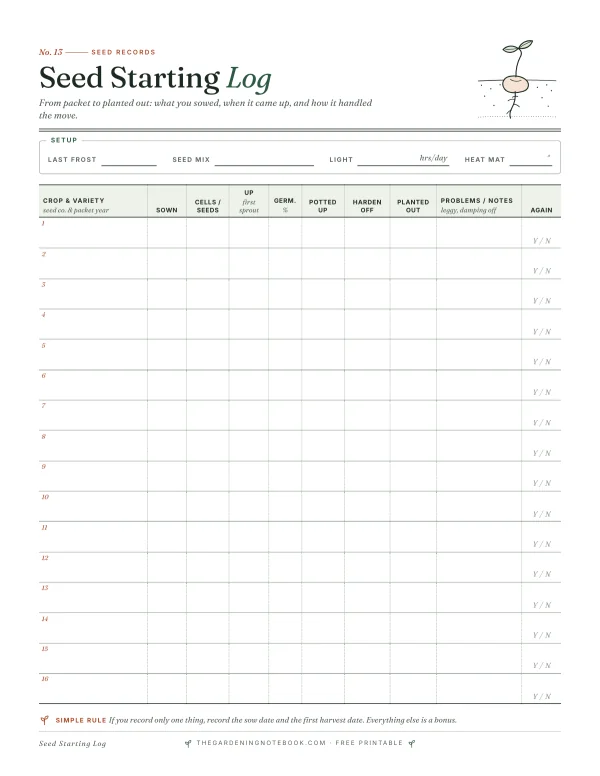
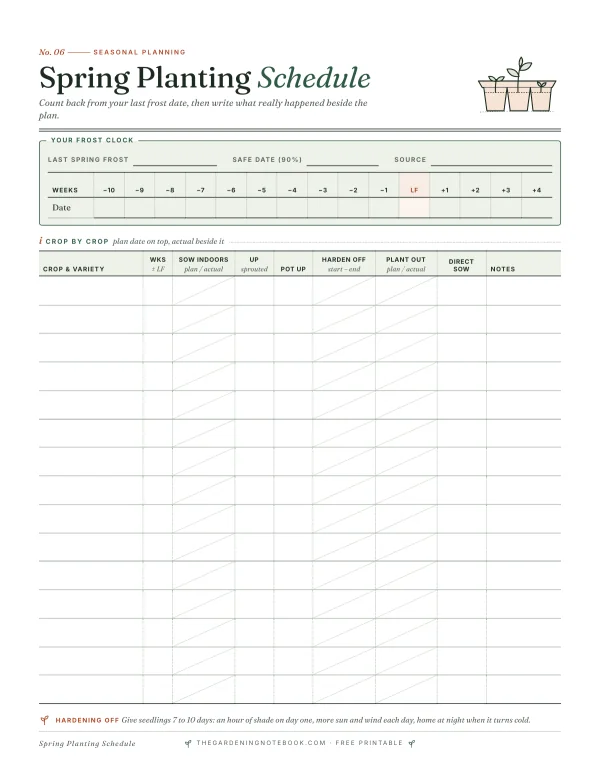
Print your season chart and clip it above the seed shelf, then tick off each sowing as you go. There's also a blank seed starting log for writing down sow dates, germination and how each variety did.
Starting seeds indoors on time
How to read a seed packet
Most packets give you the timing in weeks, counted from your last frost: "Start indoors 6 to 8 weeks before last frost." Take your frost date and count back. That's your window, and anywhere in it is fine.
Look for three more things. Days to germination tells you when to start worrying. Days to maturity, for tomatoes and peppers, usually counts from transplant, not from sowing; for beans and carrots it counts from the day you sow. Seed depth is often printed small. A good rule when it's missing: plant about two to three times as deep as the seed is wide, and barely cover tiny seeds like lettuce, since many of them need light to sprout.
When the packet and this calculator disagree, go with the packet. It's written for that variety.
Starting too early is the usual mistake
It's tempting in February. But a tomato sown twelve weeks before frost ends up tall, pale and root-bound by planting day, and it often sets fruit later than one sown at six. If you start early anyway, move seedlings into bigger pots as roots fill the cell.
Light
A sunny windowsill rarely gives enough light in late winter. Seedlings stretch toward the glass and flop. A plain LED shop light works well. Hang it a few inches above the leaves, raise it as they grow, and run it 14 to 16 hours a day on a timer. Check the fixture's instructions for distance, since stronger lights need more room.
Long, thin stems almost always mean too little light.
Temperature
Warmth drives germination. Peppers, eggplant and tomatoes sprout faster on a seedling heat mat, roughly 75 to 85°F at the soil. Lettuce, onions and brassicas sprout fine at room temperature or a little cooler. Once seedlings are up, take them off the heat. Slightly cooler air, in the 60s, keeps them stocky.
A small fan blowing gently for a few hours a day makes stems sturdier and helps keep damping-off away. Water from the bottom when the top of the mix feels dry.
Hardening off
About a week or two before transplant day, start setting seedlings outside. Begin with an hour or two in shade, out of the wind. Add time and sun each day. After 7 to 14 days they can stay out overnight, and then they're ready for the bed.
Plant out on a cloudy day or in the evening, and water right away.
Fall planting
For a fall crop you count back from the first fall frost instead. Add about two weeks to the packet's days to maturity, because growth slows as the days get shorter. Broccoli, kale, carrots and lettuce are the easiest fall crops for most gardens.
Questions people ask
When should I start tomato seeds?
Most guides say 6 to 8 weeks before your last frost date, and the plants go out after the frost has passed. Check your seed packet; early varieties may want less time.
Which crops should not be started indoors?
Root crops like carrots, beets, radishes and parsnips do best sown directly, because transplanting damages the root. Beans, peas and corn grow fast enough that starting indoors gains little. Squash and cucumbers can go either way; if you start them inside, do it only 2 to 4 weeks ahead.
Can I change the number of weeks?
Yes. Every crop's weeks can be edited to match your seed packet. Your changes are saved in this browser.
Why do my seedlings fall over?
Stretched, floppy seedlings need more light. If they collapse at the soil line and the stem looks pinched, that's damping-off, a fungus. Use fresh seed-starting mix, water from below and keep air moving.
Do I need a heat mat?
Not for everything. Peppers and eggplant sprout slowly in a cool room, and a mat speeds them up a lot. Lettuce and cabbage family crops don't need one.
Can I add these dates to my calendar?
Yes. Download the .ics file and open it. Each sowing and transplant date shows up in Google Calendar, Apple Calendar or Outlook.