Free plant spacing calculator
Plant Spacing Calculator
Enter your bed or row size and a crop, or just the spacing from your seed packet. The plant spacing calculator tells you how many plants fit, draws the layout in square or triangular spacing, and works out how many seeds to buy.
Plant Spacing Calculator
Loading the tool…
How it works
- Enter the space. A bed (length and width) or a single row (length). Inches or centimeters, your choice.
- Pick a crop or type a spacing. Choose from the list, or enter what the packet says, like "thin to 6 inches."
- Choose the pattern. Square grid or triangular (offset rows). The drawing and the plant count update as you switch.
- Get the seed count. Add the germination rate from your packet and you'll see how many seeds to sow. Print the layout, save a CSV, or open it in the bed planner.
Where the data comes from
Spacing per crop comes from extension and square foot gardening guides, listed below. Seed counts use the germination rate you enter.
- Square Foot Gardening Foundation: the method behind the squares.
All 33 sources used by the tools on this site
- Small-Scale Gardening (square foot gardening) (Clemson Cooperative Extension, Home & Garden Information Center)
- Starting Seeds Indoors (HGIC 1259) (Clemson Cooperative Extension, Home & Garden Information Center)
- Tomato Insect Pests (Clemson Cooperative Extension, Home & Garden Information Center)
- Storing Vegetable and Flower Seeds (7.221) (Colorado State University Extension)
- CMG GardenNotes #720: Vegetable Planting Guide (Colorado State University Extension (copy hosted by UC ANR))
- Vegetable Planting Guide (Hort 52) (Cornell Cooperative Extension of Rockland County)
- How to Store Seeds and Test Germination Rates (Iowa State University Extension and Outreach)
- Eastern North Carolina Planting Calendar for Annual Vegetables, Fruits, and Herbs (NC State Extension)
- Culinary Herbs for Oklahoma Gardens: Culture, Use and Preservation (HLA-6037) (Oklahoma State University Extension)
- Sowing Annual Seeds (Penn State Extension)
- HO-66-W: The Fall Vegetable Garden (Purdue University Extension)
- Companion Planting Chart (Companion Planting for Edible Crops) (UC Master Gardener Program, University of California ANR (after ATTRA))
- Marigolds (Tagetes spp.) for Nematode Management (ENY-056) (University of Florida IFAS Extension)
- Will My Seeds Still Grow? Seed Viability and Germination (University of Illinois Extension)
- Basil (University of Illinois Extension (Herb gardening))
- Chives (University of Illinois Extension (Herb gardening))
- Cilantro (University of Illinois Extension (Herb gardening))
- Dill (University of Illinois Extension (Herb gardening))
- Mint (University of Illinois Extension (Herb gardening))
- Oregano (University of Illinois Extension (Herb gardening))
- Parsley (University of Illinois Extension (Herb gardening))
- Rosemary (University of Illinois Extension (Herb gardening))
- Sage (University of Illinois Extension (Herb gardening))
- Thyme (University of Illinois Extension (Herb gardening))
- Companion planting in home gardens (University of Minnesota Extension)
- Late blight of tomato and potato (University of Minnesota Extension)
- G2090: Vegetable Garden Seed Storage and Germination Requirements (University of Nebraska-Lincoln Extension)
- Growing Vegetables: When to Plant Your Vegetable Garden [fact sheet] (University of New Hampshire Extension)
- Marigolds (University of Wisconsin-Madison Extension (Wisconsin Horticulture))
- Zinnias (University of Wisconsin-Madison Extension (Wisconsin Horticulture))
- The Pocket Gardener: A Quick Guide to Home Vegetable Gardening (Utah State University Extension)
- Square Foot Gardening: Simple, Versatile and Fun! (Washington State University Extension, Skagit County Master Gardeners)
- Companion Planting (West Virginia University Extension)
How it compares
| Tool | Format | Cost | What you get | Export and print |
|---|---|---|---|---|
| The Gardening Notebook (this page) | Interactive calculator, no account | Free, no ads | Plant count for any bed or row, square or triangular layout, seed count adjusted for germination, inches or centimeters, link to the bed planner | Print layout, CSV |
| Garden in Minutes Plant Spacing Chart | Static chart, no signup | Free | 60+ crops with plants per square foot; large crops marked as two squares per plant | Downloadable PNG image |
| Square Foot Gardening Foundation spacing guide* | Free | Spacing reference from the square foot gardening method | ||
| Phipps Conservatory Square Foot Gardening Guide* | Free | Spacing rules: 1 plant per square at 12 inches, 4 at 6 inches, 9 at 4 inches, 16 at 3 inches |
Checked in November 2026. * From search results; we could not open the full document. We didn't find another interactive spacing calculator on the first page of search results.
Use it on paper
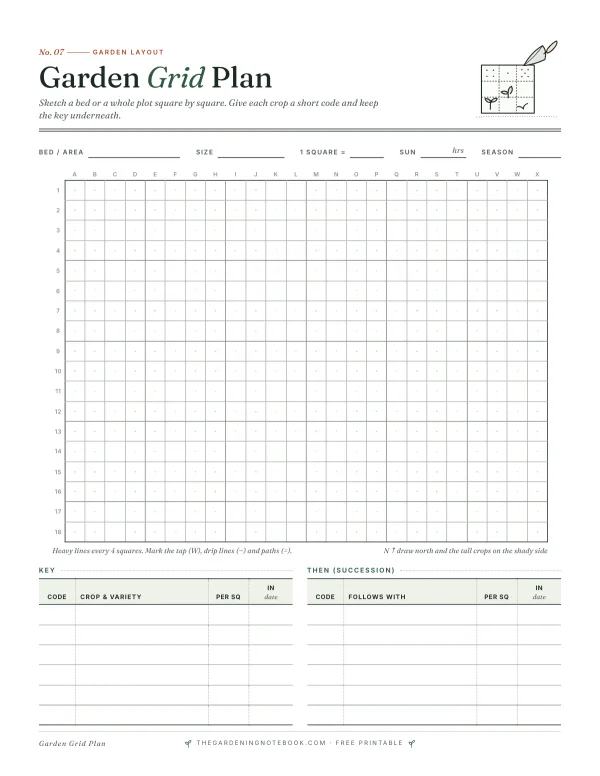
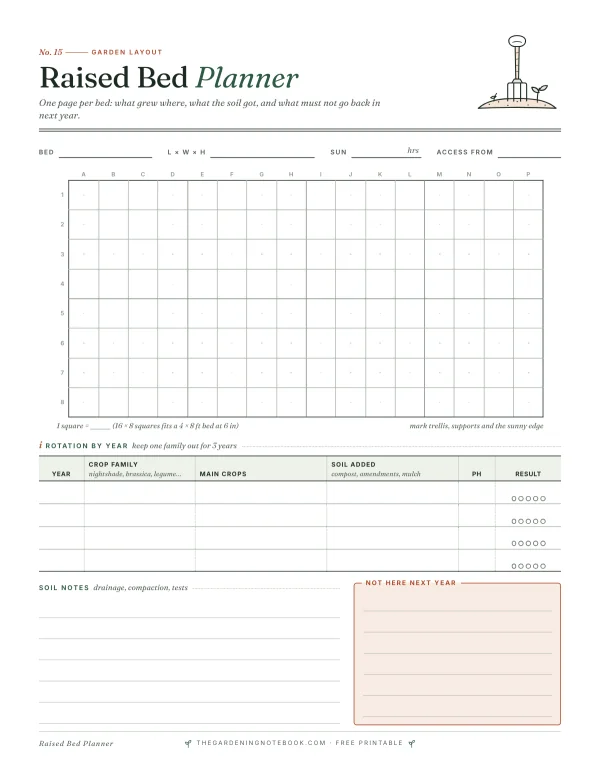
Print your layout at full size and lay it on the bed as a planting guide. If you'd rather draw your own, there's a blank square-foot grid sheet and a printable spacing chart for common vegetables.
How plant spacing works
Rows vs. beds
Seed packets were written for long farm rows. They usually give two numbers: the spacing between plants in the row, say 4 inches for beets, and the spacing between rows, often 12 to 18 inches. The wide gap between rows is for walking and hoeing.
In a raised bed you never walk between plants, so you can drop the row gap. Most gardeners use the in-row number in every direction. Beets at 4 inches, all the way across the bed. That's where the big gain in a small garden comes from.
Square foot spacing
Square foot gardening turns spacing into four easy numbers. Plants that need 12 inches get one per square foot. Six inches: four per square. Four inches: nine. Three inches: sixteen. Put in any spacing and the calculator rounds it to the nearest of these for a square-foot grid, or uses the exact distance if you'd rather.
Square vs. triangular spacing
In square spacing, plants line up in a grid, each one at the corner of a square. Easy to mark out with string, and easy to weed between.
In triangular spacing, also called offset or hexagonal spacing, every other row shifts over by half a space, so each plant sits in the gap of the row before. Every plant is still the same distance from its neighbors, but the rows sit closer together: about 0.87 times the spacing instead of the full distance. Over a whole bed that fits roughly 15% more plants at the same spacing. It's pure geometry, so it holds for any crop.
Triangular spacing pays off with crops you grow a lot of: onions, garlic, lettuce, beets, carrots. For a few tomato plants you won't notice it.
How many seeds to buy
Not every seed sprouts. The packet lists a germination rate, often somewhere from the 70s to the 90s in percent. Divide the plants you want by that rate. For 50 plants at 80%, sow about 63 seeds. Many gardeners sow two or three seeds per spot and snip off the extras, so they never get gaps.
Old seed sprouts less. If a packet is a few years old, sow a little extra, or test ten seeds on a damp paper towel first.
When to crowd and when to give room
Tight spacing shades out weeds and gets more from a small bed, as long as the soil is rich and you water well. Give extra room where air needs to move: tomatoes, squash and cucumbers stay healthier with space between leaves, because many leaf diseases spread in still, damp air. Fruit and root size also drop when plants are packed too close, so if your carrots come up thin, thin them harder next time.
Questions people ask
How many plants fit in a 4×8 raised bed?
It depends on the crop. A 4×8 bed has 32 square feet: room for about 32 peppers at one per square, 128 lettuce at four per square, or 512 carrots at sixteen. Type in your bed size and crop for an exact count.
What is a triangular plant spacing calculator?
It's a calculator that places plants in offset rows instead of a square grid. Each plant keeps the same distance from its neighbors, but you fit more in the same bed. Switch the pattern above to see the difference.
Should I use the row spacing from the seed packet?
In a raised bed you can usually ignore it and use the in-row spacing in both directions. Keep the row spacing for in-ground rows you walk between.
Can I use centimeters?
Yes. Switch units at the top of the calculator; bed size and spacing convert together.
How deep should seeds be planted?
Follow the packet. When it doesn't say, a common rule is two to three times the seed's width. Very small seeds, like lettuce and carrots, go barely under the surface.
How do I mark spacing in the bed?
Stretch string across the bed every foot for a square grid, or print the layout from this page and lay it on the soil. A stick cut to your spacing works as a quick measuring tool.