Free frost dates by ZIP code
Frost Date Calculator
Type your ZIP code and see your last spring frost and first fall frost, taken from the nearest NOAA weather station. You get two dates for each: the coin-flip date and the safe one. Underneath is a short list of what to sow this week.
Frost Date Calculator
Loading the tool…
How it works
- Enter your ZIP. We find the closest NOAA climate station and show its name and how far away it is, so you know where the numbers come from.
- Read two dates, not one. By the 50% date, half of past springs had already had their last frost. The 90% date is the one to plant tomatoes by: only about one spring in ten froze after it.
- Shift for your yard. Garden in a low spot where cold air pools? Move the dates a week later. Sheltered bed against a south wall in town? Move them earlier. The sowing list follows.
- Take it with you. Download a calendar file with "time to sow" reminders, print a card for the fridge, or save a CSV for Google Sheets or Excel.
Where the data comes from
Frost probabilities come from NOAA NCEI U.S. Climate Normals 1991–2020 (32°F threshold). ZIP locations come from U.S. Census Bureau ZIP Code Tabulation Areas. Sowing windows come from the sources listed below.
- NOAA NCEI U.S. Climate Normals: where the frost probabilities come from.
- USDA Plant Hardiness Zone Map: winter lows, for perennials rather than planting dates.
All 33 sources used by the tools on this site
- Small-Scale Gardening (square foot gardening) (Clemson Cooperative Extension, Home & Garden Information Center)
- Starting Seeds Indoors (HGIC 1259) (Clemson Cooperative Extension, Home & Garden Information Center)
- Tomato Insect Pests (Clemson Cooperative Extension, Home & Garden Information Center)
- Storing Vegetable and Flower Seeds (7.221) (Colorado State University Extension)
- CMG GardenNotes #720: Vegetable Planting Guide (Colorado State University Extension (copy hosted by UC ANR))
- Vegetable Planting Guide (Hort 52) (Cornell Cooperative Extension of Rockland County)
- How to Store Seeds and Test Germination Rates (Iowa State University Extension and Outreach)
- Eastern North Carolina Planting Calendar for Annual Vegetables, Fruits, and Herbs (NC State Extension)
- Culinary Herbs for Oklahoma Gardens: Culture, Use and Preservation (HLA-6037) (Oklahoma State University Extension)
- Sowing Annual Seeds (Penn State Extension)
- HO-66-W: The Fall Vegetable Garden (Purdue University Extension)
- Companion Planting Chart (Companion Planting for Edible Crops) (UC Master Gardener Program, University of California ANR (after ATTRA))
- Marigolds (Tagetes spp.) for Nematode Management (ENY-056) (University of Florida IFAS Extension)
- Will My Seeds Still Grow? Seed Viability and Germination (University of Illinois Extension)
- Basil (University of Illinois Extension (Herb gardening))
- Chives (University of Illinois Extension (Herb gardening))
- Cilantro (University of Illinois Extension (Herb gardening))
- Dill (University of Illinois Extension (Herb gardening))
- Mint (University of Illinois Extension (Herb gardening))
- Oregano (University of Illinois Extension (Herb gardening))
- Parsley (University of Illinois Extension (Herb gardening))
- Rosemary (University of Illinois Extension (Herb gardening))
- Sage (University of Illinois Extension (Herb gardening))
- Thyme (University of Illinois Extension (Herb gardening))
- Companion planting in home gardens (University of Minnesota Extension)
- Late blight of tomato and potato (University of Minnesota Extension)
- G2090: Vegetable Garden Seed Storage and Germination Requirements (University of Nebraska-Lincoln Extension)
- Growing Vegetables: When to Plant Your Vegetable Garden [fact sheet] (University of New Hampshire Extension)
- Marigolds (University of Wisconsin-Madison Extension (Wisconsin Horticulture))
- Zinnias (University of Wisconsin-Madison Extension (Wisconsin Horticulture))
- The Pocket Gardener: A Quick Guide to Home Vegetable Gardening (Utah State University Extension)
- Square Foot Gardening: Simple, Versatile and Fun! (Washington State University Extension, Skagit County Master Gardeners)
- Companion Planting (West Virginia University Extension)
How it compares
| Tool | Account | Cost | What you get | Export and print |
|---|---|---|---|---|
| The Gardening Notebook (this page) | Not needed | Free, no ads | Spring and fall frost dates at 50% and 90%, nearest station and distance, season length, what to sow this week, date shift for your yard | .ics calendar, print card, CSV |
| Old Farmer's Almanac Planting Calendar | Not needed (email signup optional) | Free | Lookup by ZIP or state; start-indoors, transplant and direct-sow dates for 100+ crops; moon calendar mode | Not listed on the page we checked |
| Seedtime | Free account required | Free plan with one calendar; Basic $7/month and Unlimited $14/month, billed yearly | Planting calendar built on your frost dates, task list, journal | CSV or PDF export not listed |
| National Gardening Association frost tool* | Not checked | Free | Chance of frost by date | Not checked |
| Morning Chores frost dates* | Not checked | Free | Average frost dates by ZIP, city or state | Not checked |
Checked in November 2026 on each tool's public pages. * We could not open these pages and took the details from search results, so treat them as unverified. Prices change; check the tool's own site.
Use it on paper
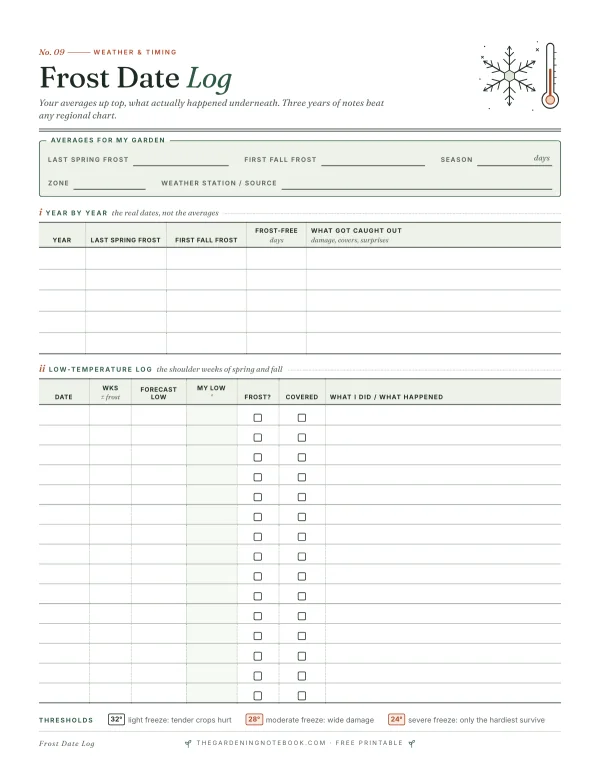
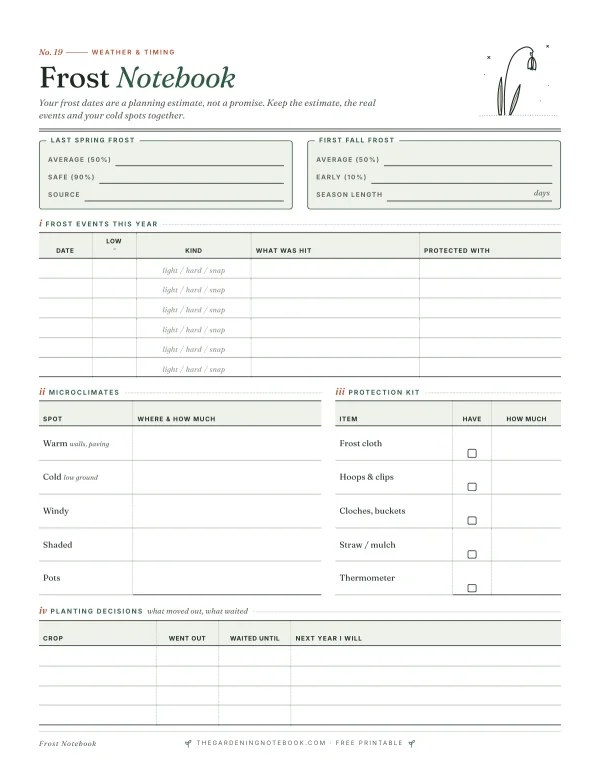
Some of us plan better with a pencil. Print the frost date card for the fridge, or use the frost log sheet to write down what actually happened in your garden each spring and fall. After two or three seasons you'll know your yard better than any station does.
How to use your frost dates
What the 50% and 90% dates mean
A frost date is a probability taken from decades of weather records, not a promise. The 50% date is the middle: in half of past years the last spring frost came before it, in half after. Plant peppers on that date and you are flipping a coin.
The 90% date sits later, usually a week or two, sometimes more. After it, the station saw a frost in roughly one spring out of ten. That's the date for tomatoes, peppers, squash, basil and anything else that dies at 32°F. Lettuce, peas, spinach and onions shrug off a light frost, so they go out weeks before either date.
In fall it runs the other way. The early date is the risky one. If your melons need another three weeks, count back from the early fall date, not the average.
Frost date vs. hardiness zone
Your USDA zone comes from the coldest winter night of an average year. It tells you whether a perennial, like a fig or a rosemary bush, can live through winter. It says nothing about when spring ends.
Two towns in zone 6 can have last frosts three weeks apart: one on a hilltop by a lake, one in a valley. For planting vegetables, the frost date is the number that matters.
Planting calendar for zones 5 through 9
People search for a planting calendar for zone 6 or zone 7 because that's the number they know. Rough rules you'll see on charts: zone 5 last frost in early to mid May, zone 6 from mid-April into early May, zone 7 in early to mid April, zone 8 in March, zone 9 in February or earlier. They are wide on purpose. Enter your ZIP above and you get your station's dates, which beats any zone average.
Hardening off seedlings
Plants raised indoors have never felt wind or full sun. Give them 7 to 14 days to adjust. Start with an hour or two outside in shade, out of the wind, and add a little more time and sun each day. Bring them in on cold nights. By the end they should spend a full day and night outside before you plant.
Skip this and the leaves can bleach white or crisp at the edges in a single afternoon.
When frost shows up after you've planted
It happens, even after the 90% date. Watch the forecast for clear, still nights with lows in the mid-30s: that's frost weather, even when the forecast says 36°F, because the ground cools faster than the air where the thermometer hangs.
- Water the bed during the day. Moist soil holds and releases more heat than dry soil.
- Cover plants before sunset with frost cloth (row cover), an old sheet or a bucket. Let the cover reach the ground so it traps warmth rising from the soil. Keep plastic off the leaves.
- Uncover in the morning once it's above freezing so plants don't cook.
Row cover adds a few degrees of protection; heavier weights add more. The label usually says how many.
If your dates look wrong
The nearest station may sit at a different elevation or by water, and that changes things. Low ground collects cold air and frosts later in spring. Cities hold heat. If you border two zones or the station is far away, use the day shift, and keep notes for a couple of seasons. Your own records beat any map.
Questions people ask
Where do these frost dates come from?
From NOAA climate normals: decades of daily temperature records at weather stations across the US. We match your ZIP to the nearest station and show its name and distance so you can judge how well it fits your garden.
What's a safe date to plant tomatoes?
Use the 90% date, and wait for nights that stay above 50°F. Tomatoes survive cool nights but sit still and sulk until the soil warms up. A week of patience usually costs you nothing at harvest.
Is a planting calendar by ZIP code better than one by zone?
Yes, for timing vegetables. Zones are drawn from winter low temperatures and cover big areas. A ZIP lookup ties you to a specific station's spring and fall records.
My neighbor's ZIP shows a different date. Why?
The two ZIPs probably map to different stations. Look at each station's distance and elevation, pick the one that sits more like your garden, and shift the dates if needed.
What counts as a frost?
The tables use 32°F measured at the station, about five feet above the ground. On a clear, calm night, plants at ground level can freeze when the station reads a few degrees warmer.
Can I put the dates in my phone calendar?
Yes. Download the .ics file and open it on your phone or computer. It adds your frost dates and sowing reminders to Google Calendar, Apple Calendar or Outlook.
Does this work outside the US?
The ZIP lookup covers US ZIP codes only. Gardeners elsewhere can type a last frost date from their national weather service into the seed starting calculator and get the same sowing schedule.